
Tuesday, August 30, 2011

Wednesday, August 24, 2011
Nigeria's Historic Opportunity

Published: May 30, 2011
ABUJA, NIGERIA — Visiting Nigeria the week of President Goodluck Jonathan’s inauguration is a special privilege. This country of nearly 160 million people, about one in five of sub-Saharan Africa, is on to something historic. The people feel it. After a sometimes agonizing half-century since independence, Nigeria is on the verge of a takeoff.
In my conversations with President Jonathan — who took the oath of office on Sunday — and with government ministers, leading businesspeople and representatives of civil society groups, I felt a firm determination to ensure that this time, in this decade, Nigeria fulfills its potential to become an African economic powerhouse and a member of the world’s leading emerging economies. In practical terms, Nigeria would like to make the BRICS — Brazil, Russia, India, China and South Africa — the BRINCS by the end of the decade.
To those who only know Nigeria as a country that squanders its oil wealth, this ambition might seem outlandish. But for those of us who have had the chance to work with its leadership, this goal seems fully with reach.
There are five solid reasons for optimism. The first is the reform that Nigeria has been undertaking over the past dozen years. The country has changed since June 8, 1998, when the brutal dictator Sani Abacha died, opening the way for a restoration of civilian rule and the strengthening of critical institutions, including the National Assembly and state and district governments.
The second is the advent of democratic elections. President Jonathan came to power last year when his predecessor, Umaru Yar’Adua, died in office. This April he won a resounding mandate of his own in elections that were praised by observers as by far the freest and fairest in Nigeria’s history. The president’s democratic mandate is not in doubt, even if tensions linger in Nigeria’s traditional north-south ethnic divide.
The third is the global wind in Nigeria’s sails. The rise of China and India is reshaping the world economy, and providing solid support for Nigeria’s growth. Commodity prices are high, as the Asian giants tap global markets. Nigeria can expect to sell not only its vast hydrocarbon deposits at good prices, but also a wide range of agricultural products and manufactured goods. The links with Asia won’t be only through exports. China is determined to be a major partner, financing core infrastructure — highways, rail and power grids — and developing major industrial capacity.
The fourth is the “age of convergence,” the tendency of developing countries like Nigeria to make unprecedented economic advances through the deployment of best practices and advanced technologies. China, of course, has been doubling its G.D.P. every seven years with blistering economic growth rates of 10 percent per year. Nigeria is enjoying robust annual growth of around 7 percent, and could catch up to China’s rate if policies are well designed and implemented. Information technologies are rapidly spreading, from the heart of sprawling Lagos to the most remote villages. For the first time, Nigeria will have a network of up-to-date information, providing a platform for sharply higher productivity and economic specialization.
The fifth is Nigeria’s commitment to tackling extreme poverty and disease throughout the nation. The president’s senior adviser on the Millennium Development Goals, working with the National Assembly, has been leading a bold mechanism to transfer federal funds to state and local governments in a robust and accountable manner. All over the country, schools, clinics and water points are being built. It’s a great honor for us at the Earth Institute to be working with the government on this initiative.
Nigeria’s international partners can also take a bow. Back in 2005, they entrusted Nigeria with partial debt relief, and the country is turning money that otherwise would have gone toward debt payments into local investments in health, education and infrastructure.
Meanwhile, a series of finance ministers has been working to end Nigeria’s image as a place of financial scams and official corruption. Prosecutors have warned international oil companies to clean up their act — even indicting Halliburton for corruption and obtaining a settlement from the company.
Of course, Nigeria still faces very real risks. The country’s population is enormously diverse, with sharp regional and religious divisions. Violence continues to flare. Global climate change poses risks to health, agricultural development and water supplies. A recent U.N. report notes that Nigeria’s rapidly growing population could exceed 700 million by the end of this century, unless family planning services are put in place. The public wants these services; the government’s challenge is to respond effectively.
I’ve watched nations on the eve of economic takeoff, in Latin America, Eastern Europe and Asia. Optimism is in the air in Abuja, and for good reason.
Friday, August 19, 2011
Thursday, August 18, 2011
Wednesday, July 6, 2011
Africa's Megacities and the Opportunities They Offer
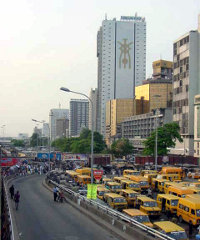 By 2030, the 18 largest cities on the African continent will have a combined spending power of US$ 1.3 trillion. How can the needs of a growing urban community create opportunities for investment and growth? Dianna Rienstra compiled the following summary from a discussion on the continent’s megacities at the recent World Economic Forum on Africa, held in Cape Town.
Lagos is West Africa's largest city.
In 2010, 14 African cities had a total population above 3 million. All African cities are growing at an accelerating pace. Energy, water and sanitation challenges exist today and are being exacerbated as increasingly people move to cities in search of a better life. New technologies are needed to meet these challenges.New, “enabling” infrastructure is needed, which will require public-private partnerships. There is a huge incentive for renewable energy and “smart water” powered by technology. Jobs will be created as smart cities are developed.
Cities – and megacities – can be incubators for innovation. Resource efficiency in these urban centers and their satellites could become a competitiveness factor as they attract domestic and foreign investment.
The Middle East focused too much on building housing for middle- and high-income people. Today, most cities in the region face critical housing shortages for low-income residents. African city planners should not make the same mistake. In Egypt, for example, there is a shortage of 1 million units. There is room for public-private collaboration to address this need. Building affordable housing is a growing market, which will create jobs.
Myriad opportunities exist for the financial services in Africa’s growing cities. Consider that in Lagos and Accra, for example, an estimated 25% of residents have access to bank accounts. Economic clusters in cities and their satellites are driven by SMEs, but most entrepreneurs, particularly women, have no access to finance to grow their businesses. By offering competitive products, financial services – particularly commercial banks – can be a driver of growth in Africa’s cities.
Cities are becoming increasingly congested and in Africa, cholera outbreaks are commonplace. To relieve this pressure, it is important to fund rural development and satellite cities. Local government involvement is key to ensure that planning meets the needs of citizens.
Megacities offer mega-opportunities, but there are no mega-solutions. Customised solutions, new technologies and new ways of thinking are needed to retrofit today’s cities and to build the sustainable urban centers and satellites of tomorrow. Future cities cannot be built on old models that do not work.
Historic African Telecom Satellite Lauched

Europe's Ariane 5 rocket lifts off from its launch pad in French Guiana carrying the Yahsat Y1A and Intelsat New Dawn satellites into orbit on Friday.
SAN JUAN, Puerto Rico — Africa's first private-sector communications satellite that will provide broadband and wireless services has been launched from South America bearing South African statesman Nelson Mandela's signature, according to a statement from Arianespace on Saturday.
The Ariane 5 took off late Friday from French Guiana carrying the Intelsat New Dawn, which was built through a joint venture with Intelsat and Convergence Partners consortium. The satellite also was imprinted with a Zulu phrase that means: "Go Well, New Dawn."It joins 21 other Intelsat satellites serving Africa.
Also launched was the Yahsat Y1A, the first satellite operated by the United Arab Emirates' Al Yah Satellite Communications Co. It will provide customized relay services for governments and businesses in Africa, Europe, the Middle East and Southwest Asia.
The Ariane 5 was carrying a record 10,050 kilograms (22,156 pounds).
The satellites were supposed to be placed in orbit in late March, but Arianespace, the commercial arm of the 13-country European Space Agency, postponed the launch after reporting problems with the rocket's main engine.
Subscribe to:
Posts (Atom)